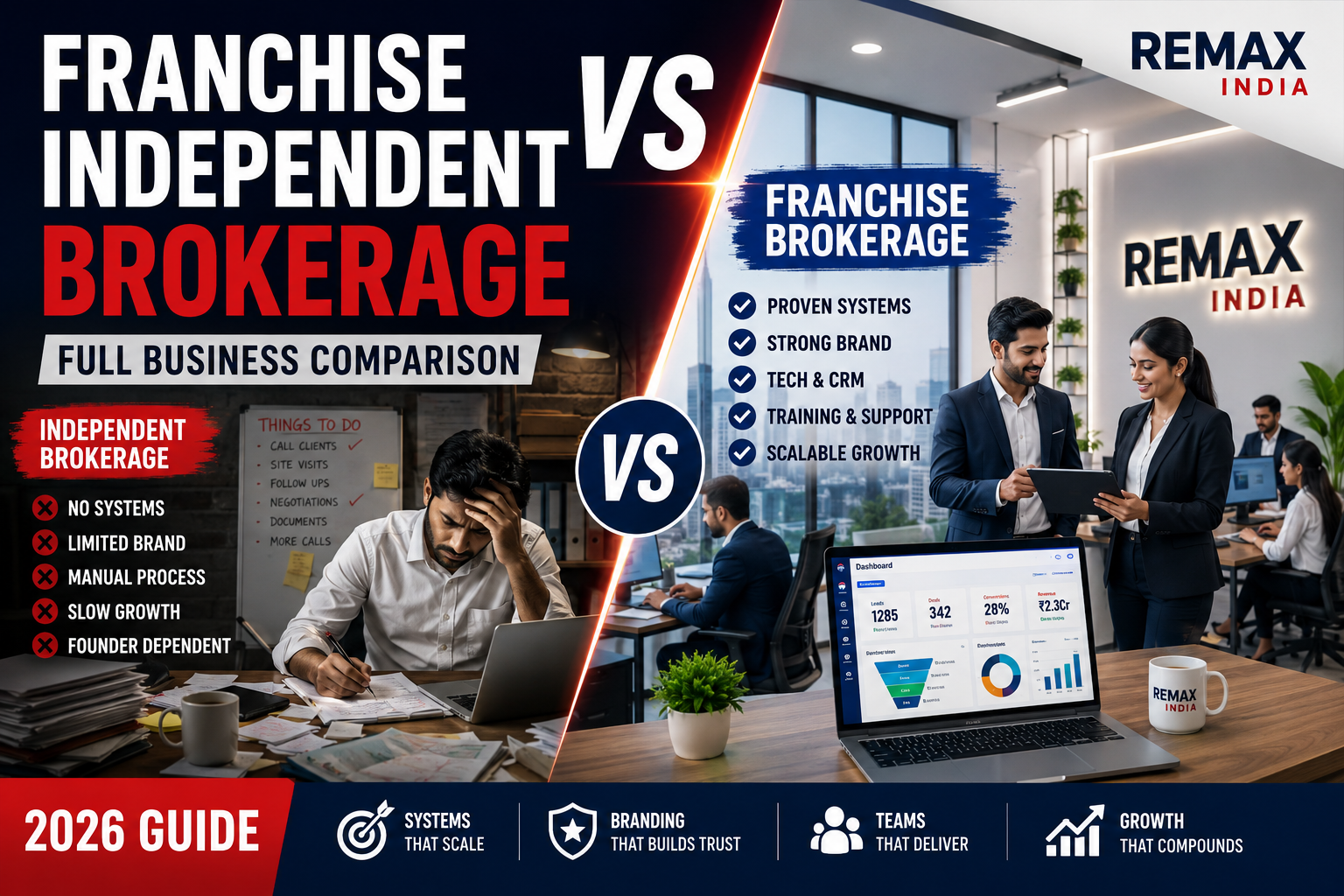
Franchise vs Independent Brokerage — Full Business Comparison
One of the biggest decisions a broker or entrepreneur faces in Indian real estate today is this:
Should you build an independent brokerage from scratch?
Or join an organised franchise network?
And honestly?
Most people make this decision emotionally instead of operationally.
Some brokers say:
“Franchise mein freedom nahi hoti.”
Others say:
“Independent rehna better hai.”
But very few people actually sit down and compare the business models properly.
Because this is not just a branding decision.
It’s an infrastructure decision.
A scalability decision.
A long-term operational decision.
And in Indian brokerage, the operational structure underneath the business usually matters far more than people realise.
The Core Difference Most Brokers Miss
Independent brokerage gives maximum freedom.
Franchise brokerage gives structured systems.
That’s the real tradeoff.
One prioritises independence.
The other prioritises scalability.
Neither model is automatically perfect. But both create very different operational realities once the business starts growing.
Independent Brokerage vs Franchise Brokerage
| Area | Independent Brokerage | Franchise Brokerage |
|---|---|---|
| Brand Recognition | Build from zero | Existing market trust |
| CRM Systems | Self-managed | Usually structured |
| Training | Self-learned | Provided systems |
| Marketing | Create independently | Brand-supported |
| Recruitment | Harder initially | Easier with brand trust |
| Operational Setup | Trial & error | Pre-built frameworks |
| Scalability | Founder dependent | Process-driven |
Why Most Independent Brokerages Struggle To Scale
Starting independently sounds attractive initially because there’s complete control.
No franchise fee.
No brand rules.
No operational structure to follow.
But once the brokerage starts growing, operational complexity increases rapidly.
Suddenly you need:
- CRM systems
- lead management
- recruitment structure
- training systems
- branding consistency
- marketing processes
- agent onboarding
- documentation workflows
This is where many brokerages become chaotic.
Everything still depends on the founder.
And founder dependency eventually creates growth limits.
The Biggest Advantage Franchises Have
The biggest advantage organised franchise models have is speed.
Instead of building everything from scratch, franchise partners plug into systems that already exist.
That includes:
- branding
- training
- technology systems
- marketing infrastructure
- recruitment frameworks
- operational SOPs
- network support
Building this independently can take 3–5 years.
Sometimes longer.
And many brokerages never fully build it properly.
Typical Business Setup Timeline
| Business Component | Independent Setup | Franchise Setup |
|---|---|---|
| Brand Recognition | 2–5 years | Immediate |
| Operational Systems | Build manually | Pre-existing |
| Agent Recruitment | Slow initially | Faster with brand trust |
| Training Process | Create internally | Structured onboarding |
| Market Positioning | Long-term effort | Existing positioning |
Why Branding Matters More Than Earlier
10 years ago, buyers mostly cared about local broker relationships.
Today buyers research online before even speaking to agents.
That changes everything.
Because now branding itself creates trust before the first conversation happens.
Especially in:
- NRI transactions
- luxury property sales
- commercial leasing
- premium residential projects
Clients spending ₹2–5 Crores usually prefer organised communication and structured brokerage operations.
Not random “Sir trust me” sales processes.
The Hidden Problem With Complete Independence
Most brokers think independence automatically means higher profits.
Sometimes true.
But incomplete.
Because independence also means:
- higher operational burden
- slower growth
- more trial & error
- brand-building costs
- technology decisions
- marketing experimentation
A franchise fee may look expensive initially.
But rebuilding everything independently is often far more expensive over 5–7 years.
Most people never calculate that properly.
Which Model Makes More Money?
This depends entirely on execution quality.
A badly managed franchise office can fail.
A strong independent brokerage can become extremely successful.
But statistically?
Organised systems usually scale faster because operations become repeatable.
And repeatability is where business value gets created.
| Brokerage Type | Growth Ceiling | Operational Dependency | Scalability |
|---|---|---|---|
| Solo Independent Broker | Moderate | Very High | Low |
| Independent Brokerage Office | High | Founder dependent | Moderate |
| Organised Franchise Office | Very High | Process-driven | High |
The Future Of Brokerage In India
Indian brokerage is becoming more structured every year.
Buyers expect professionalism.
Developers expect organised channel partners.
Investors expect systems.
NRIs expect process transparency.
This is slowly pushing the market toward organised brokerage models.
Not because independent brokers are disappearing.
But because client expectations are becoming more sophisticated.
Aur sophisticated markets eventually reward systems.
Final Thoughts
The real question is not:
“Franchise ya independent?”
The real question is:
Which model matches your long-term business goals?
If someone wants maximum flexibility and local relationship-driven operations, independent brokerage may work well.
But if someone wants:
- scalable growth
- structured systems
- branding support
- team expansion
- operational infrastructure
then organised franchise models become significantly more attractive.
Because eventually, brokerage becomes less about individual hustle…
…and more about business infrastructure.